

How a trapped-ion quantum computer works
Our quantum computer will store information in single calcium ions, held in empty space by electric fields and controlled with lasers. Here is how, step by step.
1
A qubit is a tiny, well-behaved two-state system
A normal computer bit is 0 or 1. A quantum bit, or qubit, can be in a blend of both at once, and several qubits can be linked so that they share a single state. That is where a quantum computer's power comes from.
The hard part is finding a qubit that nature leaves alone. A single atom is ideal: every calcium ion is identical, and one of its electrons can sit in two energy levels that last for over a second. Isolate the ion from everything else and those two levels become a very clean 0 and 1.
2
Holding an ion in empty space
An ion carries an electric charge, so electric fields can push it around. But a rule of physics called Earnshaw's theorem says no arrangement of fixed charges can hold it still. Any field that pushes it back towards the centre in one direction lets it escape in another, like a ball on a horse saddle.
A Paul trap does exactly that, using a radio-frequency voltage of about a thousand volts oscillating 20 to 30 million times a second. On average, the ion feels a gentle bowl and stays at the centre.
Try it: how hard can you drive the trap?
The slider sets the trap strength, a number physicists call q. The line shows the ion's position over time.
Two motions appear together. The slow swing, secular motion, is the ion rolling in the average bowl. The fast jitter on top, micromotion, is the ion being shaken by the flipping field. Push q past about 0.91 and the trap throws the ion out. Our trap is designed to run at q of 0.4 or less.
3
Making the ion
We start with a small oven that releases a thin vapour of calcium atoms into the vacuum chamber. Two lasers turn one of these atoms into an ion inside the trap.
The first laser, at 423 nm, is tuned exactly to calcium, so it lifts an electron only in calcium atoms and ignores anything else in the chamber. The second, near 390 nm, has enough energy to tear that electron away. What is left is a positive Ca+ ion, and the trap catches it.
4
Cooling it with light
A freshly made ion is hot and moves fast. To slow it down we shine a violet laser at 397 nm, tuned slightly below the colour the ion absorbs.
Because of the Doppler effect, an ion moving towards the laser sees the light shifted up to exactly its colour, absorbs it, and gets a small kick backwards. Moving away, it barely absorbs at all. Millions of kicks a second slow it to a thousandth of a degree above absolute zero.
While it is being cooled, the ion scatters violet light in all directions. A sensitive camera can see this as a single glowing dot: one atom, visible.
5
Computing: flipping the qubit with a very steady laser
Our qubit is the ion's ground state (0) and a long-lived upper state called D5/2 (1). A deep-red laser at 729 nm moves the ion between them. Shine it for the right time and the qubit flips from 0 to 1; stop halfway and it is in an equal blend of both.
This only works if the laser keeps a perfectly regular rhythm. A laser whose colour wobbles by more than a few hertz, out of 411 trillion, quickly scrambles the qubit.
Try it: how steady does the laser need to be?
The line shows the chance of finding the qubit in state 1 as the pulse gets longer. The slider sets how much the laser's colour wobbles (its linewidth).
To make qubits work together, we use the fact that ions in a chain push on each other. When one ion is kicked, the whole chain wobbles, and that shared motion lets a laser link the state of one ion to another.
6
Reading the answer
To read a qubit, we turn the 397 nm laser back on. If the ion is in 0, it scatters light and glows. If it is in 1, it is parked in the upper state, out of reach of the violet light, and stays dark. Bright means 0, dark means 1.
Afterwards, a laser at 854 nm lifts the ion from the upper state to a short-lived level, from which it drops straight back to 0. The ion is reset and ready for the next run.
Six lasers, six jobs
| Laser | Stage | What it does | How steady it must be |
|---|---|---|---|
| 423 nm | Make the ion | First step of turning a calcium atom into an ion | 1–5 MHz |
| ~390 nm | Make the ion | Second step: knocks the electron free | not critical |
| 397 nm | Cool it | Slows the ion; makes it glow | 1–5 MHz |
| 866 nm | Keep cooling | Rescues the ion when it falls into a dark state | 1–10 MHz |
| 729 nm | Compute | Flips the qubit between 0 and 1 | 1–10 Hz |
| 854 nm | Reset | Empties the qubit's upper state | 1–5 MHz |
The qubit laser has to be about a million times steadier than the others.
7
Where our lab is today
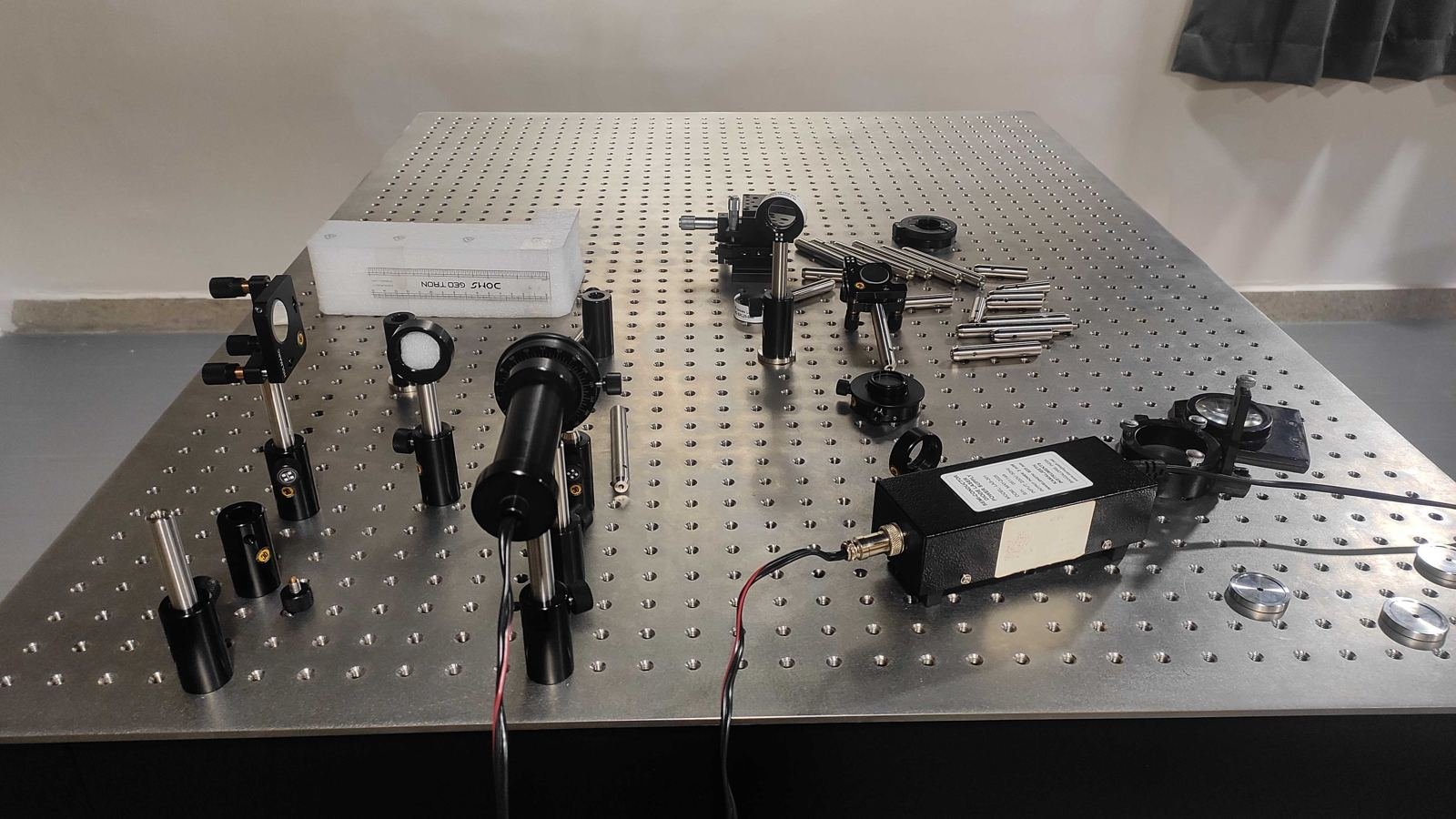
In our first year we designed a blade-type linear Paul trap for calcium ions and worked out how to run it:
- Trap size
- About 1 mm from centre to electrode
- Drive
- 1 to 1.5 kV at 20 to 30 MHz
- Trap strength
- q of 0.4 or less
- Ion's swing
- 1 to 5 million times a second
We also set up the lab's power and grounding, the optical table, and an acousto-optic modulator that switches and fine-tunes laser beams. Next come machining the trap, the RF drive, the ultra-high vacuum, and the lasers, until we see our first glowing ion.
Adapted from the 2025–26 work report of Vishwa Chandrasekaran, Junior Research Fellow, Delta Q.